
Don't Let Your Business Lines Go Dead in 2027
Traditional phone services are scheduled to close on 31 January 2027. Get your free readiness assessment and personalised migration plan before it's too late.
What is the 2027 PSTN switch-off?
The PSTN switch-off is the planned closure of traditional analogue phone services on 31 January 2027. Check landlines, ISDN and devices that dial over them with your provider. Physical copper-exchange closures follow a separate schedule; broadband migration depends on your service.
Openreach schedule · checked 28 September 2026
PSTN switch-off: dates & devices
A quick reference to the phone-service deadline and the equipment worth checking now.
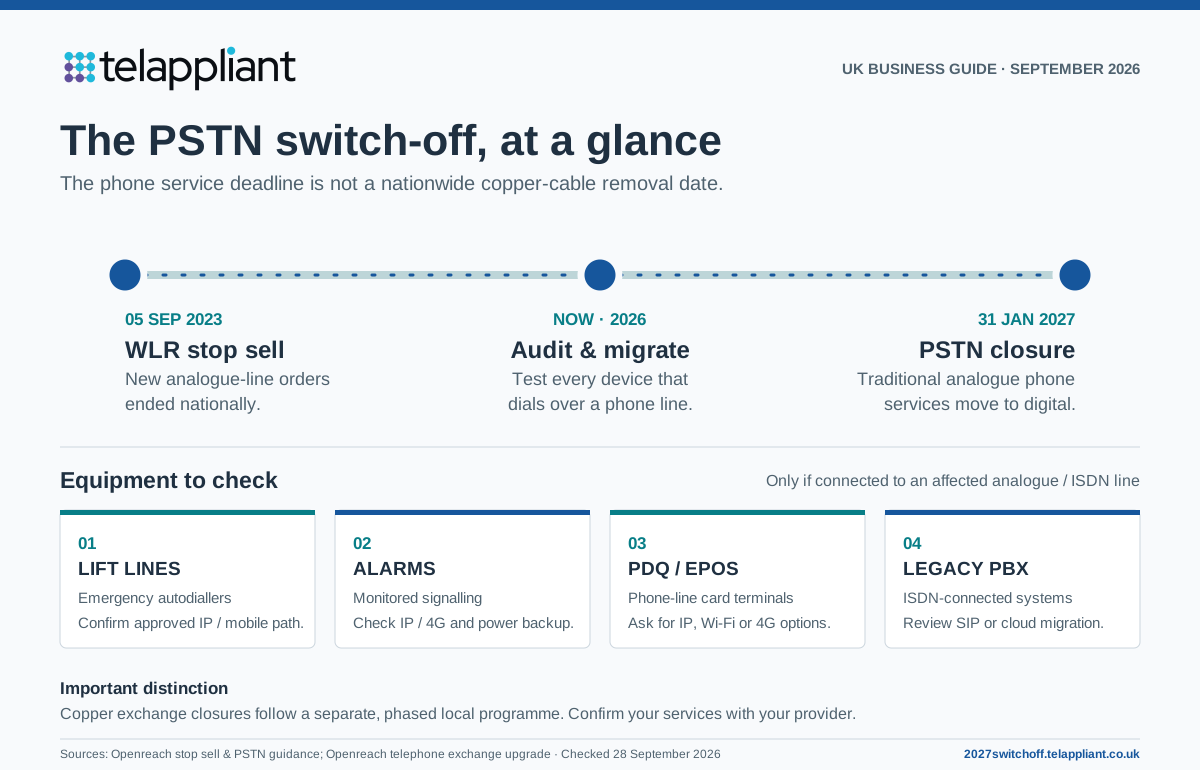
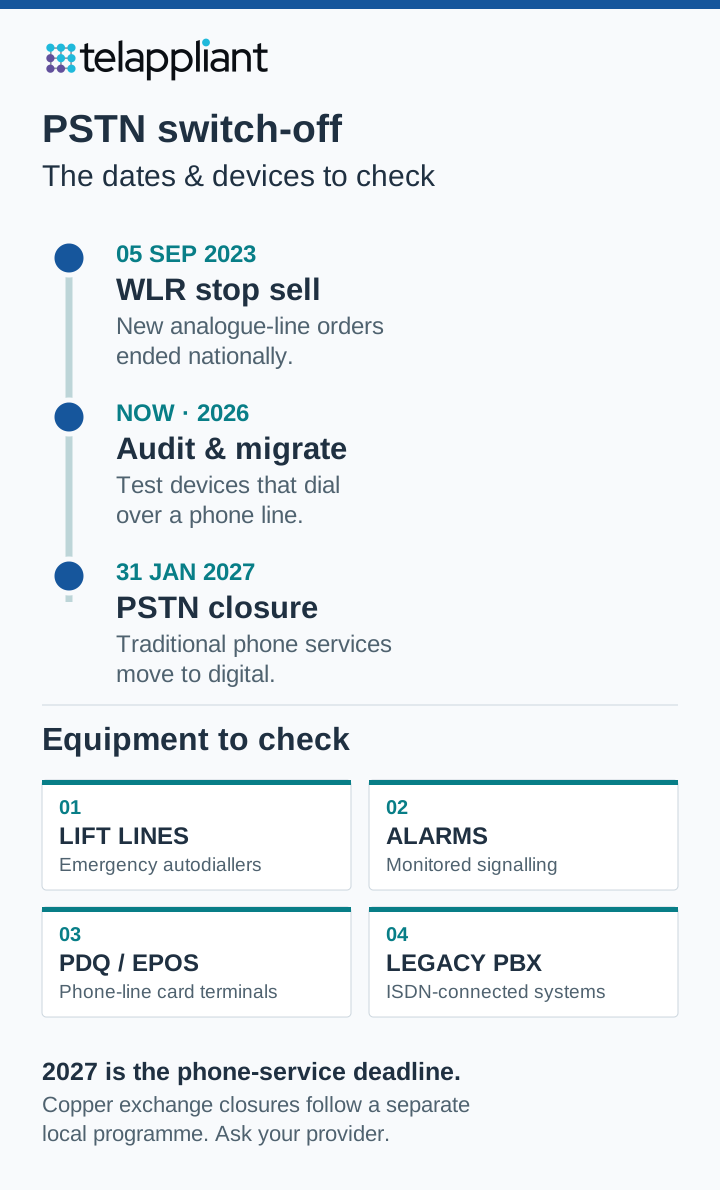
- 01 / 5 September 2023
Nationwide WLR stop sell
New orders for traditional analogue-line products ended nationally; existing lines could continue until withdrawal.
- 02 / Now · 2026
Audit and migrate
Check each phone line and anything connected to it with the relevant service or equipment provider.
- 03 / 31 January 2027
PSTN closure
Traditional analogue phone services move to digital. Copper exchange closures are a separate, phased programme.
The 2027 deadline concerns traditional phone services, not the removal of every copper cable. Openreach’s physical exchange closures follow a separate local programme. If your broadband shares an analogue line, ask your provider about the right standalone replacement.
Ask your providers about these connections
Check your setupLift emergency phones
Ask the lift maintainer whether the autodialler still uses an analogue line, and how emergency calls and backup power will work after migration.
Read guidanceMonitored alarms
Ask the alarm provider how signals reach the monitoring centre and whether an IP or mobile path and backup are needed.
Read guidancePDQ / card terminals
Ask the payment provider if your terminal dials over a phone line or already uses IP, Wi-Fi or mobile data.
Read guidanceLegacy PBX / ISDN
Ask your phone-system provider which trunks serve the PBX and whether SIP or a cloud phone system fits your site.
Read guidance
What's Affected in Your Business?
Check which services and devices you need to review before 2027
Phone Lines
Traditional landlines and ISDN connections will stop working.
Broadband
If broadband is bundled with a traditional phone line, ask your provider what standalone service is needed.
Critical Devices
Alarms, EPOS, lifts, and fax machines may need replacement or adapters.
Choose Your Migration Path
Three proven routes to digital communications, tailored to your needs
Not Sure Which Solution Fits?
Answer 3 quick questions to get a personalised recommendation
Does your business use Microsoft 365 (Teams, Outlook)?
Your 4-Step Migration Journey
A smooth transition with expert guidance at every stage
Assess
Take our readiness quiz to understand your current setup and what needs to change.
Plan
Work with our experts to design the right solution for your business.
Implement
We handle the technical migration with minimal disruption to your operations.
Support
Ongoing support and training to ensure you get the most from your new system.
Trusted by UK Businesses
Join hundreds of companies who've already made the switch
Businesses Migrated
Uptime Guarantee
Support Available
Years Experience
Understanding the PSTN Switch-Off
Everything UK businesses need to know about the biggest telecoms change in decades
The Public Switched Telephone Network (PSTN) has been the backbone of UK telecommunications since the 1800s. Built on copper wiring, it carries traditional analogue voice calls and supports ISDN lines used by thousands of businesses for phone systems, fax machines, alarm systems, and payment terminals. Openreach, the infrastructure arm of BT, has confirmed that the entire PSTN network will be permanently decommissioned by January 2027.
Businesses still relying on analogue phone lines, ISDN2 or ISDN30 should plan a move to digital voice. If broadband is tied to one of those lines, ask the provider how it will be supplied separately. Openreach's nationwide WLR stop sell began on 5 September 2023; this stopped new orders of traditional analogue-line products, not existing service on that date.
Who is affected?
Any organisation using traditional landlines, ISDN voice channels, analogue alarm lines, lift emergency phones, EPOS terminals on phone lines, or fax machines connected to the PSTN will need to act. This includes offices, retail premises, warehouses, care homes, schools, GP surgeries, and multi-site enterprises. Even businesses that have already moved to VoIP for voice calls may still have legacy analogue lines powering door entry systems, franking machines, or building management systems.
What are the alternatives?
Businesses have three primary migration paths. Cloud Communications (SelectVoice) replaces your entire phone system with a modern, AI-powered platform hosted in the cloud — ideal for businesses wanting a fresh start with features like voicemail-to-text, call recording, and sentiment analysis. SIP Trunking lets you keep your existing on-premise PBX hardware but connects it to the digital network via internet-based voice channels. Teams Direct Routing adds full PSTN calling to Microsoft Teams, perfect for organisations already invested in Microsoft 365.
What about broadband?
Broadband bundled with an analogue phone line needs a provider-led migration plan, but the PSTN phone-service deadline does not mean every copper broadband connection stops on the same day. Options may include SoGEA (Single Order Generic Ethernet Access), which provides broadband without a traditional phone service, FTTP (Fibre to the Premises), or Ethernet leased lines. Telappliant can assess the services available at your site.